Contemplations on Spirit
'In this blog I contemplate the means to understand one self and the motivation that moves us to unfold in heart and soul.'
Zlatovláska - Goldenhair,
with Jung and the tropical zodiac

The Serpent, the Animals and the Old King: a Czech Fairy Tale Read through Jung and von Franz
1. The Fairy Tale as a Map of the Soul
Once upon a time there was a king so wise that nothing in his realm remained hidden from him. Every day he had a dish brought to him, and no one was allowed to know what it held. In some tellings it is a strange fish, in others a serpent. His servant Jiří had to prepare the dish without tasting it. But one day curiosity won out over the command. Jiří took a small bite, and at that very moment he heard voices outside the window. It was the birds, talking among themselves. He understood them.
So begins Zlatovláska, Goldenhair, the Czech fairy tale that Karel Jaromír Erben recorded in 1865. It is related to the Brothers Grimm's The White Snake. In both stories a man tastes something forbidden to him and through it gains access to a language older than humankind: the language of nature itself. What follows is a journey past ants, ravens and fish, through trials that seem impossible, towards a woman with hair of gold. In Erben's version that journey ends with a beheading, a resurrection and a new king on the throne.
Whoever reads fairy tales as children's stories misses what they truly are. As early as 1912, C.G. Jung saw a deep kinship between myth and dream. In his view, you can withhold the content of the old myths from a child, but never the need for them. If all traditions were to vanish at a single stroke, the next generation would begin the whole of mythology anew. Story is not an ornament of the soul. It is one of its natural forms of expression.
Marie-Louise von Franz, Jung's closest collaborator, went a step further. She saw in the fairy tale the collective psyche in its purest and simplest form. A myth carries the colours of a people, a culture and an era. A fairy tale has largely shed them. It takes place "long ago", in a land that lies nowhere, among figures without surnames. That is exactly why it speaks to everyone. According to von Franz, all the figures in a fairy tale together describe a single psychic process. The king, the servant, the animals and the golden-haired princess are not separate people but forces within one soul.
That makes fairy tales useful as maps. Not to know what will happen, but to recognise where we are.
In this post I read Zlatovláska through the method of Jung and von Franz. I follow the story step by step: the forbidden dish, the grateful animals, the trials, and the dark ending in which an old king dies and a new one rises. Each time I ask the same question: what is happening here in the soul?

2. Tasting from the Hidden Dish
The king in our tale is wise, but his wisdom rests on a secret. Every day he eats in seclusion from a dish no one may see. Von Franz often reads the king in fairy tales as the ruling attitude of consciousness: the way a person, or a whole culture, orders and understands the world. This king knows a great deal, but he keeps the source of his knowledge hidden, even from his most trusted servant.
Then Jiří breaks the command. It is an ancient and recurring moment. Eve eats from the tree, Prometheus steals fire, Pandora opens the jar. Again and again, consciousness begins with a transgression born of curiosity. In the language of depth psychology, this is not disobedience as a moral failing. It is the moment a person is no longer content with second-hand knowledge and wants to taste for themselves what the king's wisdom is made of.
What Jiří tastes is the serpent, or in some tellings a fish. Both are cold-blooded creatures of the depths, of earth and water. They are far removed from the human world of words and rules. Jung points to a striking parallel in Germanic legend. Siegfried slays the dragon Fafner, tastes its blood and afterwards understands the language of birds. According to Jung, the hero thereby enters into a peculiar relationship with nature, and in the end he wins the treasure. The knowledge the serpent gives is not knowledge about nature. It is knowledge from within nature.
Elsewhere in the same work, Jung describes the serpent as an image of life energy turning inward. Through that inward movement, he writes, a person is fertilised, inspired and reborn. He also calls the serpent an excellent symbol of rebirth, because it sheds its skin. Whoever tastes of the serpent is first drawn inward, towards instinct, dream and body, before anything new can emerge.
That makes this knowledge uncomfortable. It comes from below, not from above. It is instinctive, enveloping, sometimes poisonous. It cannot be ordered up or planned. You usually taste it by accident, or against your own intentions, just as Jiří did. And once you have tasted it, there is no going back. The birds keep talking, whether you want to hear them or not.
It is telling that Jiří then hears mainly animals. He does not understand gods or scholars, but sparrows, ants, ravens and fish: the smallest and most overlooked voices. It is precisely this new sensitivity that will soon save him.
When did you last taste something you knew you were not really supposed to know? And which voices have you since begun to understand that you could not hear before?
3. The Grateful Animals
Jiří leaves the court, and that is no coincidence. Once you have tasted the serpent, you can no longer remain in the old king's service. In the tale, the king himself sends him out to fetch the golden-haired princess. Psychologically, however, something else begins here: the journey of someone who has started to hear the world differently.
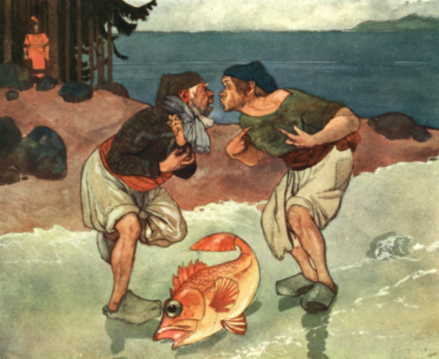
On the way he meets an animal in need three times. He sees a colony of ants about to be trampled, and he turns aside. He finds young ravens that have fallen from their nest and are close to starving. To feed them, he sacrifices his own horse. He returns a fish to the water.
Each time the same promise sounds: we will remember you.
These are no random animals. They come from the three realms of nature. The ants belong to the earth, the ravens to the air and the fish to the water. Together they form a world, and Jiří now has a bond with each of those realms.
Jung wrote extensively about the role of animals in fairy tales. In his essay on the phenomenology of the spirit in fairy tales, he shows that the spirit appears not only as the wise old man. It also takes animal form, as a creature that speaks, gives advice or shows the way. The animal then stands for a wisdom that lies deeper than conscious thought: the wisdom of instinct. As early as 1912, Jung wrote that animal symbols express the animal life energy in human beings.
Von Franz turned this into a practical lesson. In fairy tales the hero rarely succeeds through strength or cleverness alone. He succeeds because he has a good relationship with the animals, and therefore with his own instinctive nature. The hero who ignores, mocks or harms the animal gets stuck. The hero who listens and helps later finds the help he himself needs. You could say that the animals in the tale are not repaying favours. They show what happens when a person treats their instinct with care rather than contempt.
The most striking moment is the sacrifice of the horse. The horse is the animal that carries Jiří. It is his speed, his strength and his standing as a rider. Jung saw the sacrifice of an animal as the sacrifice of one's own animal nature. Elsewhere he describes how the story of the horse sacrifice passes over into the self-sacrifice of the hero. That deeper sacrifice he calls the giving up of the infantile personality, so that a more mature personality can emerge.
In the tale, however, the sacrifice is offered not to a god but to something small and vulnerable: two hungry young birds. Jiří gives up his own strength to feed new life. Afterwards he continues on foot, more slowly, closer to the ground. He has given up something that carried him, and so he moves through the world differently.
That may be the heart of this episode. The serpent's knowledge alone is not enough. Jiří understands the animals, but that understanding only gains meaning when he acts on it. He answers with care, and that care costs him something. The tale draws a distinction here that we easily forget: listening to your instinct is not the same as using it. Whoever hears the voices from below only to profit from them remains the old king's servant. Whoever answers them becomes someone else.
Which "horse" is carrying you through life right now, and what would happen if you gave it up for something small that needs your care?
4. The Trials
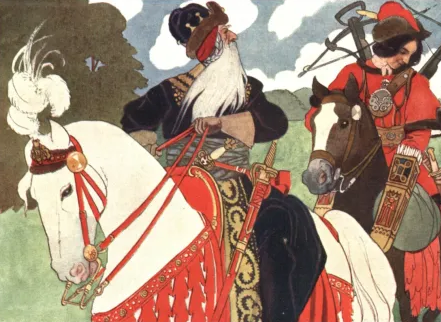
Jiří reaches the court where Zlatovláska lives. Whoever wishes to take her away must first prove himself worthy. In Erben's version he is given four tasks.
- He must find, one by one, the pearls of a broken string scattered through the tall grass.
- He must retrieve from the seabed a ring the princess has dropped into the sea.
- He must fetch the water of life and the water of death from beyond the edges of the known world.
- Finally, he must recognise Zlatovláska among her sisters, who all look exactly alike.
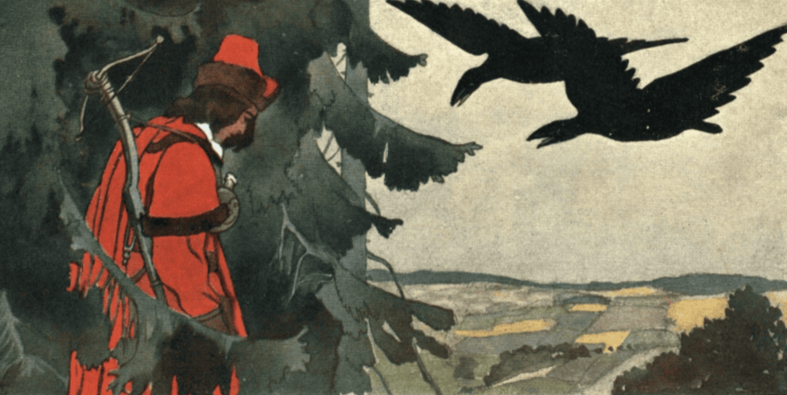
Jiří cannot accomplish any of these tasks himself. He sits in the grass at night in despair, stands powerless on the shore, and has no idea where to find the water of life. Then the animals come. The ants gather the pearls. The fish brings the ring. The ravens fly to the end of the world and return with two small flasks of water. At the final trial a fly buzzes around the head of the right princess.
What the Ego Cannot Do
This is the heart of the episode, and von Franz pointed to it again and again. The tasks in a fairy tale are almost always impossible for the conscious ego. That is neither coincidence nor dramatic exaggeration but exactly the point. The story shows that there is a limit to what will, strength and reason can achieve. When the ego reaches that limit, help must come from another layer of the psyche. Jung called this the compensatory function of the unconscious. What consciousness cannot do, the unconscious sometimes can, provided there is a relationship with it.
Jiří built that relationship along the way. He spared the ants, fed the ravens and returned the fish. Now that it truly matters, the forces he treated with care return to him. The trials are therefore not really a test of his abilities. They are a test of his relationships.
Four Tasks, Four Capacities
Each trial asks for something different, and together they form something close to a path of learning.
Sorting. Gathering pearls from the grass is work of patience and discernment. The motif is familiar from the story of Cupid and Psyche, in which Psyche must separate a heap of mixed seeds and ants again come to her aid. Von Franz discussed that scene at length. It concerns the ability to see, amid the chaos of impressions and feelings, what belongs together and what does not. That ability is not grand. It is small, patient and bodily, the way an ant colony works.
Retrieving. The ring lies at the bottom of the sea. A ring is a circle, an ancient image of wholeness and connection. Jung saw the circle as one of the most important symbols of the Self. What has been lost lies in the depths, and only a creature of those depths can bring it up.
Life and death. The third task goes further than all the others. The water of life and the water of death lie beyond the edge of the world, and only birds can reach them. In many traditions ravens are messengers between worlds. In alchemy, about which Jung wrote extensively, the raven stands for the nigredo, the black phase of dissolution with which every transformation begins. That Jiří needs precisely these two waters is a foreshadowing. He does not know it yet, but he will need them himself.
Recognising. The final trial is the most subtle. The sisters all look alike. Appearance does not help, and neither do strength or patience. Only a fly, the smallest and most despised creature of all, shows the way. What is truly valuable cannot be recognised from the outside.
The Fourth
It is telling that there are four trials, and that the fourth differs from the first three. Jung often wrote about the old alchemical axiom of Maria Prophetissa: one becomes two, two becomes three, and out of the third comes the one as the fourth. In Jung's thought, the fourth is the element that makes the other three into a whole, and at the same time the hardest to reach. In our tale the first three trials concern things: pearls, a ring and water. The fourth concerns a person. Here it is no longer about retrieving something, but about truly seeing someone.
Which task in your life feels impossible right now? And which small, forgotten strength within yourself may you once have helped, without knowing you would one day need it?
5. The Beheading and the Water of Life and Death
Jiří returns with Zlatovláska. He has passed every trial, and the tale seems complete. Then the unexpected happens. Back at court, the old king has Jiří beheaded. The hero who accomplished the impossible tasks lies dead on the ground, his head severed from his body.
Here Zlatovláska departs sharply from the Grimms' The White Snake, where the hero simply marries and lives happily. Erben tells a darker and older story. In the Czech version the journey ends not in a wedding but in death.
Then Zlatovláska steps forward. She asks for the body, places the head back on the trunk and sprinkles both with the water of death. Head and body grow together again, and the wound closes without a scar. Then she pours the water of life over him. Jiří rises as if waking from a deep sleep, younger and more beautiful than he has ever been.
Why the Water of Death First?
The order is striking, and it is no accident. In the Slavic fairy-tale tradition, the two waters each have their own task. The water of death heals and joins: it brings together what was separated, but it does not bring it to life. The water of life animates: it restores the breath. You cannot use the second without the first. What lies in pieces must first become whole before it can live.
That is a deep psychological truth. After a great rupture in life, a loss or a crisis in which someone has quite literally "lost their head", we often want to live, feel and move forward again straight away. The tale says: first the broken part must grow back together. That work is quiet and invisible. It still feels like death, but it is the precondition for everything that comes after.
Dismemberment and Restoration
Jung saw in this motif one of the oldest images of transformation. He points to the Egyptian myth of Osiris, who is killed and cut into pieces. Isis gathers the parts of his body, helped by the jackal-headed god Anubis. Jung remarks that here the nocturnal devourers of bodies become helpers in the restoration. Elsewhere he sums up the fate of Osiris: he passes into the mother's womb, is dismembered, re-formed, and reappears in his son.
In alchemy too, about which Jung later wrote at length, this image returns again and again. In the visions of the alchemist Zosimos, a figure is dismembered and reassembled, and the old formula solve et coagula, "dissolve and bind", describes the same process. According to this tradition, transformation is never simply growth. The old must first fall apart before it can be joined together in a new form.
In that sense the beheading is not a punishment but a passage. The head, seat of thought and control, is separated from the body. What Jiří has been until now, the clever servant who fulfilled every task, must die. The one who rises is someone else.
Zlatovláska Is No Prize
Here the role of the golden-haired princess also changes. Until this moment she seemed above all the reward: something to be fetched, won and brought home. Now she turns out to be the one who holds the waters. She decides over death and life.
In the same work Jung discusses the Egyptian hymn in which the old sun god Ra is stung by the serpent. Only Isis can heal him, with her wisdom and her words full of the breath of life. Von Franz, too, often saw the feminine figure in fairy tales as the mediator with the unconscious: the one who knows the way to forces the conscious ego cannot reach. Zlatovláska stands in that tradition. Jiří did not conquer her. He proved worthy of her, and that is why she can bring him back.
And so the third trial is explained in hindsight. Jiří fetched the water of life and death for another, but without knowing it, he fetched it for himself. What the ravens brought him in gratitude for his care becomes the means of his own rebirth.
Yet the tale is not over. Someone is still standing at the side, watching: the old king, who sees his servant rise from death younger and more radiant. And he wants the same.
What in your life has fallen to pieces and is still waiting for the water of death, the quiet work of becoming whole, before it can live again?
6. The Old King and the New
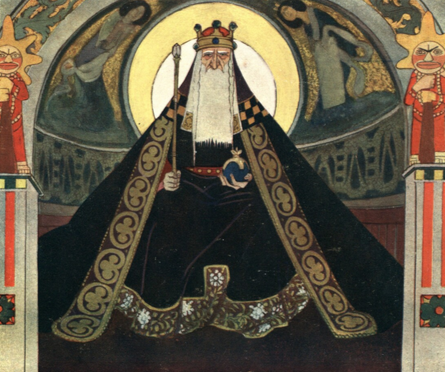
The old king has seen it all. His servant lay dead on the ground and now rises, younger and more radiant than ever. The king is old, and he wants the same. He orders that his own head be cut off too, so that Zlatovláska can rejuvenate him with the wondrous waters.
The order is carried out. But the old king does not rise again.
Then Jiří becomes king. He marries Zlatovláska, and together they rule the land. So the tale ends.
A Cruel Ending?
To a modern reader this is a shocking conclusion. Is it revenge, cunning, or a lesson about greed? The tale does not explain. It only tells what happens. Precisely because of that, it forces us to look beyond a moral lesson.
Von Franz read the king in fairy tales, as we saw earlier, as the ruling attitude of consciousness: the principle that for a time gives order to a life or a culture. Every such principle grows old. What was once alive and fertile becomes rigid. That is why so many fairy tales begin with an old or ailing king and end with a new one. The hero is then often the youngest, the simplest or, as here, a servant: the one nobody expects.
Jung developed this motif in his last great work, Mysterium Coniunctionis, in the chapter on king and queen. In the alchemical imagery he discusses there, the old king must die, dissolve or drown before he can return as a new king. The renewal of the ruler is not an improvement of the old. It is a death and a rebirth.
Why Does the King Not Rise?
That is the question the tale leaves us with. Jiří and the king undergo the same thing: the beheading, and then the waters. Yet one rises and the other does not.
The difference lies not in the moment of dying but in the road leading to it. For years the king ate from the hidden dish. He already knew the language of the animals. But he used that knowledge for himself, in secret, as a source of power. He never spared an ant, never sacrificed a horse, never passed a trial. He has no relationship with the animals, and no relationship with Zlatovláska. He wants the result of transformation without the transformation itself.
Jung often warned against exactly this temptation: imitating an inner path instead of truly walking it. In Psychology and Alchemy he writes about the difference between outwardly copying an example and living through for oneself what that example means. Whoever copies only the form remains unchanged. The king's beheading is an imitation. Jiří's was a surrender.
We find a striking parallel again in Jung, in the Egyptian hymn about Ra. The old sun god is stung by the serpent and healed by Isis. But according to Jung, he recovers only in part: he loses his power and finally withdraws. There too, the old principle does not return in its former glory. It makes way.
A King with a Queen
There is one more detail that is easily overlooked. The old king rules alone. There is no queen in his story. His wisdom is solitary and hidden, and his realm lacks the feminine.
The new king rules together with Zlatovláska. In Jung's language this is the coniunctio: the union of opposites, of masculine and feminine, of conscious and unconscious. The new consciousness that emerges at the end of the tale is not stronger or cleverer than the old. It is more complete. It has taken in the connection with what the old one shut out.
The Old King Within Us
Whoever reads the tale as an image of a single psyche will see that the old king does not stand outside us. He is the attitude that served us well for a long time: the way of thinking, controlling and surviving that brought us to where we are. That attitude also wants to renew itself. But it would rather do so without giving anything up: to grow young without dying, to change without losing control.
On this point the tale is relentless. It cannot be done. The old principle must step down from the throne, and the new must earn its way through relationship, care and surrender. What rises is not the old king in a new body, but someone who came from below.
Which old king within you wants to be rejuvenated without dying? And what would change if you allowed him to hand over the throne?
7. Closing: What Goldenhair Teaches Us
We began with a hidden dish and end with a throne. Between them lies a road the tale describes with great precision.
First Jiří tastes what is forbidden, and through it he begins to hear the world. Then he answers those voices with care, even when it costs him. He faces trials he cannot pass alone, and he is helped by the very forces he once protected. He dies, is made whole and rises again. And finally the old king, who wanted everything without giving anything up, makes way for a new one, who reigns together with Zlatovláska.
According to von Franz, all the figures in a fairy tale together describe a single psychic process. Read Zlatovláska that way, and it becomes a story about what happens within a person when old knowledge is no longer enough. The serpent, the animals, the waters and the princess are not aids from outside. They are parts of ourselves we have long ignored: instinct, the body, patience, the depths, and the feminine power to connect and to animate.
The tale does not promise easy renewal. It does promise that renewal is possible, for whoever truly walks the road. Not by copying what someone else did, but by listening to the smallest voices, giving up one's own horse when needed, and not avoiding death when it comes.
Goldenhair is not conquered. She chooses who rises again.
Mercury Returns to the Core
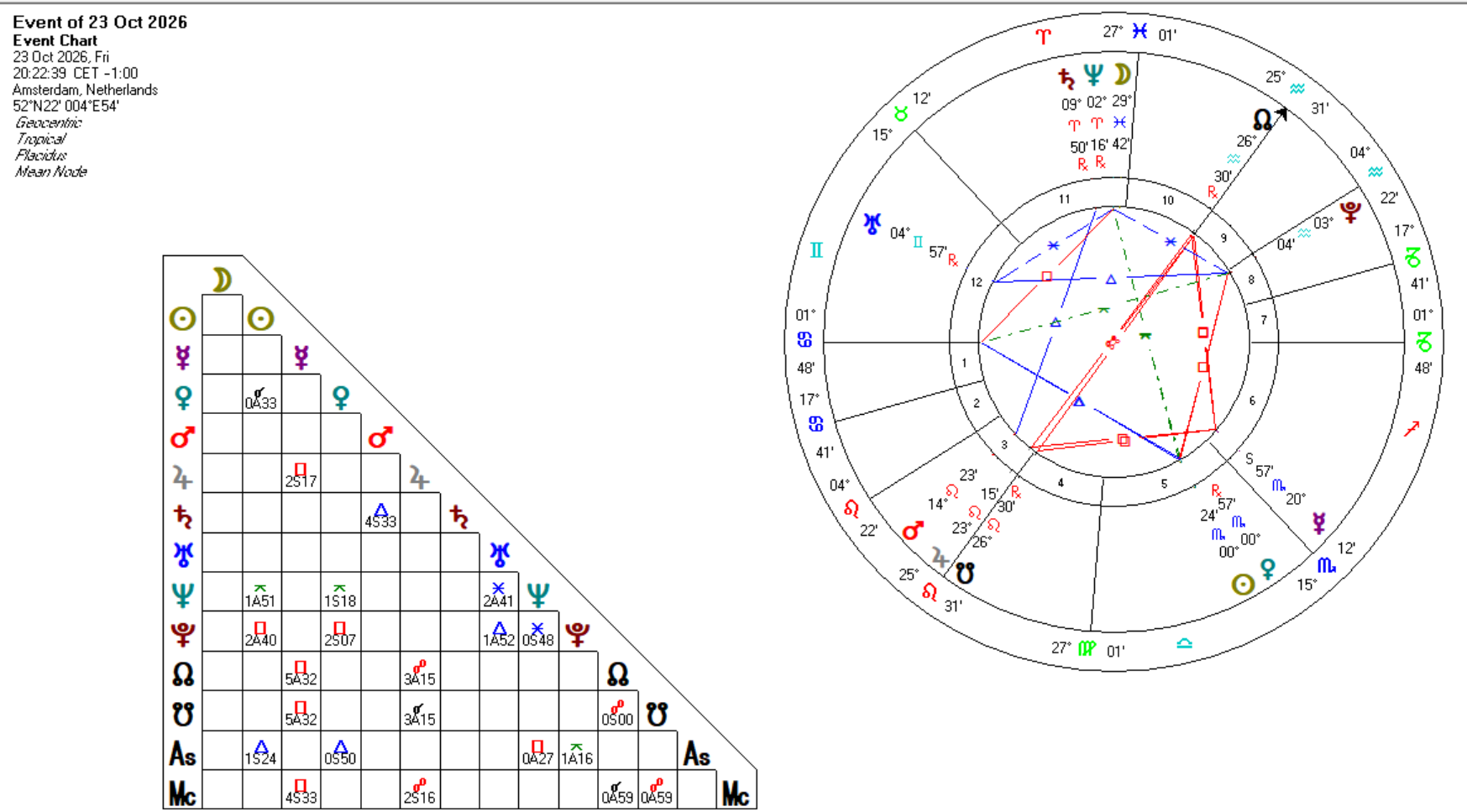
These days, embarking on Scorpio season lead by the Sun changing signs on the 23rd. Mercury is turning retrograde in tropical Scorpio. On 24 October he stations at 21° Scorpio, and until 13 November he moves back to 5°, without ever leaving the sign.
Mercury, the Greek Hermes, is more than the planet of thought. He is the messenger between worlds, the translator and the god of trade: of the exchange of words, facts, data and goods, and of where our interest is drawn. In many ways Jiří is a Mercurial figure. He is a servant and a messenger, he steals a bite from the king's dish, and he understands the language of every creature.
In Scorpio, Mercury does not want to stay on the surface. This is enhanced by the squaring of Jupiter in Leo and the Lunar Nodes creating a visionary expansiveness and increasing meaningful catalytic urge. He wants to know what lies beneath things and to get to the core, even when that core is uncomfortable. That is exactly the movement of our tale: from the hidden dish, past the bottom of the sea, to the border between life and death. Jung also described the alchemical Mercurius as a serpent and as an ambiguous water, at once poison and remedy. It is hard not to think of the water of death and life.
Venus, the planet uniting opposing forces, mending in harmony, finding comfort on all plains, is also retracing her steps. She has been retrograde since 3 October at 8° Scorpio, squaring Pluto, Scorpios ruler today again for a few days. Read the previous push in this Lunation here and more on Pluto in this Blog. She moves back into Libra on 25 October, and turns direct at 22° Libra in the night of 13 to 14 November. So both planets teach us to look what we exchange and what we truly value, just as Jiří only sees at the end that Zlatovláska is no prize, but the one who decides over life and death.
A retrograde Mercury travels back over the road he has already taken. It is a good time, like Jiří after his trials, to return to court and look at what has truly changed. What knowledge have you tasted? Which exchanges, conversations and facts deserve a second look? And which old king still wants to be rejuvenated without dying?
A final question for you as a reader: if you were to return to the core of one matter in your life these coming weeks, which would it be?
Thanks for reading xx
Melanie Webb 102026
Sources
Primary sources
Erben, Karel Jaromír. "Zlatovláska." In Sto prostonárodních pohádek a pověstí slovanských v nářečích původních. Praha, 1865.
Grimm, Jacob & Wilhelm. "Die weiße Schlange" (KHM 17). In Kinder- und Hausmärchen. Göttingen, 1857.
Images
Arthur Scheiner
Solar Fire 9
C.G. Jung
Jung, C.G. Wandlungen und Symbole der Libido. Leipzig/Wien: Deuticke, 1912. English: Psychology of the Unconscious, trans. B.M. Hinkle. New York: Moffat, Yard & Co., 1916, pp. 29-30, 268, 272, 276, 333-334, 398, 415, 469, 479. Revised: Symbole der Wandlung. Zürich: Rascher, 1952 (CW 5).
Jung, C.G. Psychologie und Alchemie. Zürich: Rascher, 1944 (CW 12, Psychology and Alchemy).
Jung, C.G. "Die Visionen des Zosimos" (1938; revised 1954). CW 13, Alchemical Studies.
Jung, C.G. "Der Geist Mercurius" (1943). In Symbolik des Geistes. Zürich: Rascher, 1948 (CW 13, Alchemical Studies).
Jung, C.G. "Zur Phänomenologie des Geistes im Märchen" (1945). In Symbolik des Geistes. Zürich: Rascher, 1948 (CW 9/I, The Archetypes and the Collective Unconscious).
Jung, C.G. Mysterium Coniunctionis, 2 vols. Zürich: Rascher, 1955-1956, chapter "Rex und Regina" (CW 14).
Marie-Louise von Franz
Franz, Marie-Louise von. The Interpretation of Fairy Tales. Zürich/New York: Spring Publications, 1970; revised ed. Boston: Shambhala, 1996.
Franz, Marie-Louise von. A Psychological Interpretation of The Golden Ass of Apuleius. Zürich/New York: Spring Publications, 1970; revised ed. The Golden Ass of Apuleius: The Liberation of the Feminine in Man. Boston: Shambhala, 1992.